TICKET SALES TERMINATED
Tickets are currently unavailable on TicketWeb
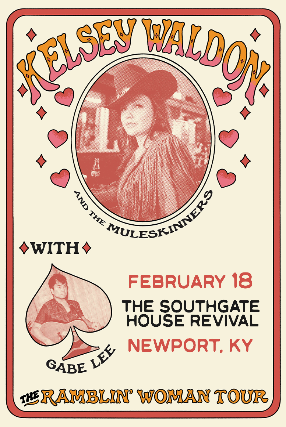
The Ramblin' Woman Tour w/Kelsey Waldon and the Muleskinners, Gabe Lee
Wed, 18 Feb, 7:00 PM EST
Doors open
6:30 PM EST
The Southgate House Revival - Sanctuary
111 E Sixth Street, Newport, KY 41071
TICKET SALES TERMINATED
Tickets are currently unavailable on TicketWeb
Event Information
Age Limit
18+
Alternative Country
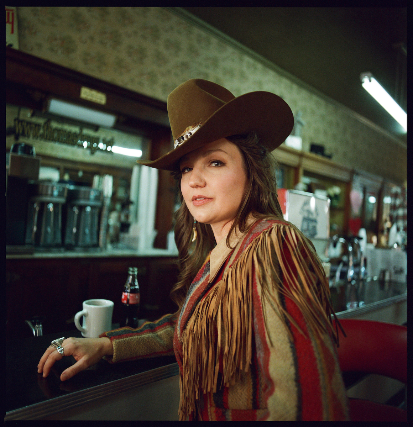
Kelsey Waldon
Kelsey Waldon
Alternative Country
Kelsey Waldon is one of Country music’s most singular voices. Across four acclaimed full-length albums full of both “heavy twang and spitfire pedal steel” and “coffeehouse confessionals” (Rolling Stone), she’s brought listeners into her world and shared her own experiences and perspectives. Her new project, There’s Always a Song (out May 10th via Oh Boy Records/Thirty Tigers), however, is about the singular voices that shaped her into the artist she is today.
“It’s like, I kind of was able to find my voice through these voices, you know?” Waldon says. “A part of me doing this album is expressing so much gratitude for the music that I love, for music that has meant a lot to me and helped me.”
These eight songs, from the earliest pages of the country and bluegrass music songbooks, helped the singer-songwriter from Monkey’s Eyebrow, Ky., find her place in the world before she became an artist whose own work generates buzz, lands on year-end best-of lists, and, in 2019, led Waldon to become the first artist in 15 years to sign a deal with John Prine’s Oh Boy Records. These days, they remind Waldon of why she wanted to make music in the first place.
“There’s a lot of bullshit out there, and sometimes our goals and dreams get clouded by competition or become jaded. [These songs are] like something tapping into me and being like, ‘That’s why you love this.’ It feels like home to me; it feels like the truth,” Waldon shares. “It just brought me so much joy to work with my peers, my friends, people I really admire.”
There’s Always a Song might not even exist, in fact, if not for S.G. Goodman, who in addition to also being a fellow western Kentuckian has been one of Waldon’s good friends since before they were making headlines with their music. During one of their frequent catch-up phone calls, Waldon told Goodman she would love to find a reason to collaborate and asked Goodman if she’d be up for recording a song together. Goodman suggested “Hello Stranger,” specifically citing the 1973 version by Hazel Dickens and Alice Gerrard.
Waldon didn’t stop with Goodman, though. Fellow John Prine devotee and “kindred spirit” Amanda Shires joins Waldon on fiddle for the Bill Monroe classic “Uncle Pen” — arranged in half time like Goose Creek Symphony’s version from 1971 — while Isaac Gibson, lead singer of 49 Winchester, helps Waldon honor his fellow Virginian, Ralph Stanley, on the devastating “I Only Exist.” Margo Price, one of Waldon’s first friends in Nashville, rounds out the list of guests, singing with Waldon on “Traveling the Highway Home,” which Waldon selected from fellow Kentuckian Molly O’Day’s catalog.
Waldon’s band, meanwhile, was a key inspiration for There’s Always a Song. The songs on this album are among those they frequently listen to in the van while on tour; Waldon and fiddler Libby Weitnauer, in particular, have bonded over their love of old-time and Appalachian music. They’d been out on the road for much of the year before they entered Nashville’s Creative Workshop studio (prominently featured in Heartworn Highways and a longtime Nashville staple) to make this record, which Waldon co-produced with GRAMMY Award-winning engineer/mixer/producer Justin Francis.
“These songs are deep. They were here long before me, and they will be here long after I’m gone, after any of us are here. They will survive the test of time,” Waldon says. “It’s like they live in some kind of universe that just survives forever. These songs know the secrets to life.”
Waldon is featured in the 2024 edition of the Country Music Hall of Fame's "American Currents" exhibit, and she'll perform a special "Songwriter Session" on March 2nd at the museum as part of the exhibition's opening. 2024 tour dates will be announced soon.

Country Folk
Gabe Lee
Gabe Lee
Country Folk
Equal parts classic songwriter and modern-day storyteller, Gabe Lee has built his own bridge between country, folk and rock over the course of three acclaimed albums. His latest release, The Hometown Kid, finds him distilling those sounds into something sharp and singular, examining his roots as a Nashville native along the way. As warm and welcoming as Lee's Bible Belt birthplace, The Hometown Kid is a record about arrivals and departures, homes and homecomings, the places we leave and the lessons we carry with us.
Raised by Taiwanese immigrants, Lee grew up surrounded not only by Nashville's rich legacy of country music, but also the classical songs and gospel hymns that his piano-playing mother performed weekly in church. "A lot of my friends' parents were musicians, too," he remembers. "Music was always around me, and it became the driving force for everything I did."
Before he could launch his career as one of Nashville's hometown heroes, though, Lee first needed to leave town. Craving new horizons, he headed to Indiana, where he finished college with degrees in literature and journalism. Living in the Midwest gave him a renewed perspective on his Nashville roots, and when he returned home, he began writing songs that drew upon the narrative skills he'd sharpened as a student. His debut album, 2019's farmland, focused on his timeless melodies and deft delivery, while 2020's Honky Tonk Hell showcased a widescreen version of Lee's countrified sound. The reception was seismic. Rolling Stone praised Honky Tonk Hell as one of the "30 Best Country and Americana Albums of 2020," and Lee found himself sharing shows with Jason Isbell, Los Lobos, and other artists who, like him, embraced the full spectrum of roots music.
"I've always loved storytellers like John Prine and Paul Simon, as well as piano-driven singers like Billy Joel and Jackson Browne," says Lee, who nods to his heroes on The Hometown Kid. "You can hear those influences on this record. That blend is really important to me, because it lends itself to an original sound. Three records into my career, this is something I've been chasing and am happy to have reached: an honest mix of who I am as a writer."
A mix of autobiography and richly imaginative character studies, The Hometown Kid finds room for southern piano ballads, amplified rock, intimate folk songs, and gospel rave-ups. The stories themselves are equally diverse. Laced with childhood memories and hometown references, the anthemic "Rusty" unfolds like a love letter from a restless road warrior to the city he's left countless times before. Songs like "Buffalo Road" (named after a country lane that Lee visited often during his teenage years, "just to sneak away with my friends, look at the stars, and be somewhere else") and "Wide Open" continue exploring the push and pull of one's birthplace. "Kinda Man" paints a different picture, with lyrics that detail the hard-won wisdom and half-baked follies of a salt-of-the-earth dishwasher who worked alongside Lee during his days as a bartender. A track that's equal parts country song and southern fable, "Never Rained Again" is a song about taking a rougher road that eventually leads to greener pastures, while the empathetic "Lonely" takes its inspiration from fellow songwriter Justin Townes Earle, who passed away during the lockdown of 2020.
Lee recorded The Hometown Kid during his busiest year as a touring musician, finding time between shows to enter Farmland Studio — where he also created his two previous albums — with a band of country pickers and heartland rockers. Together, they laced his songs with electric guitar, upright piano, pedal steel, and fiddle. On "Longer I Run," they veered between Motown-worthy grooves and country-western swing. On "Angel Band," they mixed gospel grit with holy-roller reverence. Most of the songs were tracked live, with Lee — his voice in sharp shape, fine-tuned by a schedule of rapid-fire gigs — delivering the most compelling performances of his career. After several days of recording, he'd inevitably hit the road again, bidding another temporary goodbye to Nashville. No wonder The Hometown Kid is so nuanced with its depiction of the comings and goings of a wandering soul — it was created amidst a backdrop of goodbyes, arrivals, late-night drives, early-morning wake-up calls, and life-affirming shows.
"This album is about departing and returning to your hometown," he says. "More specifically, it's about the discovery, searching, and maturing that comes not only with being gone, but with returning to the place you come from."
There's more discovery to be done. As The Hometown Kid moves into its second half, the electrified drive of the album's earlier moments gives way to something more subtle but equally stunning. "The energy changes toward the end," admits Lee, "and that's because the story is unfinished. There's more to come. My earlier records were both concluded by a 'goodbye song' that helped tie everything together, but this one isn't like that. It leaves things more open-ended. When The Hometown Kid ends, we're still trying to figure out who we are. We're sure of our roots in Nashville, but where does that get us? Where do we go with that? We'll answer that question on the next record."
Like a collection of postcards sent from various stops along the road, The Hometown Kid is a snapshot of an artist in motion. It's the soundtrack to a journey that's forever unfolding, with Gabe Lee writing not only about where he's going, but where he's been, too.