TICKET SALES TERMINATED
Tickets are currently unavailable on TicketWeb
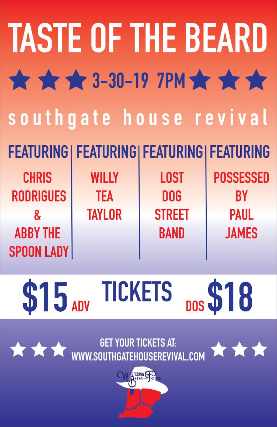
Taste of The Beard 2019
Sat, 30 Mar, 7:00 PM EDT
Doors open
6:30 PM EDT
The Southgate House Revival - Sanctuary
111 E Sixth Street, Newport, KY 41071
TICKET SALES TERMINATED
Tickets are currently unavailable on TicketWeb
Event Information
Age Limit
18+
Folk Revival
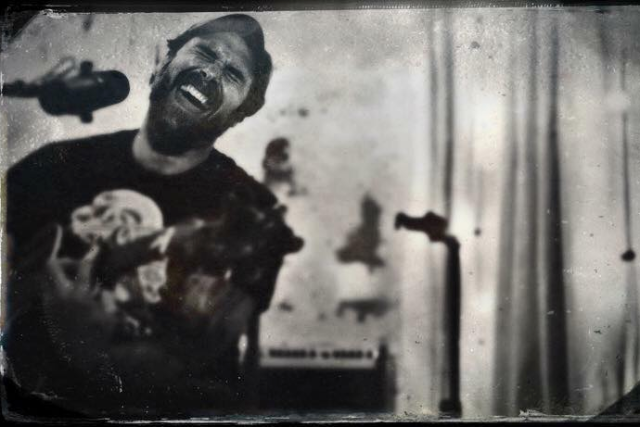
Possessed By Paul James
Possessed By Paul James
Folk Revival
Fans of singer/songwriter and one man band Possessed By Paul James my be surprised to find out that playing music is not his only passion. Though he somehow finds the time to make appearances all over the US and Europe throughout the year, down in the Texas Hill Country he’s in charge of an elementary school special education classroom, teaching children with intellectual disabilities. And you may think that with juggling so many responsibilities between music and work that he wouldn't have the energy or the time to excel at either one. But Possessed by Paul James is not your average musician, or teacher. - Saving Country Music
Country Folk
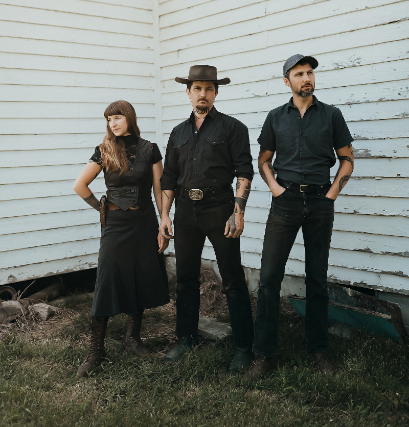
Lost Dog Street Band
Lost Dog Street Band
Country Folk
Returning to the stripped-back, string band sound of their busking years, Lost Dog Street Band’s new album Glory is a searing testament to recovery, redemption and resolve. Fronted by songwriter Benjamin Tod and his wife, fiddler Ashley Mae, the DIY band began out of desperation on the sidewalks of Nashville roughly a decade ago, but now sustains a significant national audience that’s drawn to their authentic songwriting, old-time instrumentation, and hard-won independence. “I wanted to make an album with the specific intention of being raw but full at the same time and to get back to our roots,” Benjamin Tod says. “Everyone on this album has been a busker. Douglas Francisco, who plays slide guitar — I met him on the streets busking. Jeff Loops, our bassist, was in a busking band, too. That flavor was important to me, just getting back to the root of things.” By centering the songs of Glory around acoustic arrangements, without the drums or steel guitar of prior albums, these harrowing personal stories become even more graphic. It’s a feeling that Benjamin Tod himself describes as “a logical glimpse of climbing out of hell.” He observes, “Something that was shocking to me was realizing that as soon as I got sober, that was really the beginning of the journey. Choosing to get sober was barely even a milestone.” Leading the album, “Until I Recoup (Glory I)” vengefully demands justice and describes the fight for glory after it’s been unjustly taken away. The lyrics read like a mission statement of redemption. Similar to Steve Earle’s influential Train a Comin’ album from 1999, Glory conveys the hard work that goes into getting clean, particularly in tracks like “Fighting Like Hell to Be Free,”“Beautiful Curse” and “Jalisco Bloom.” Calling to mind the skillful writing of Guy Clark or Townes Van Zandt, “What Keeps Me Up Now” views that phrase from multiple angles, from sleepless nights to a suicide attempt, where “the belt was a noose when I came to on the ground.” It’s one example of the “dark country” description that the band occasionally uses to describe their sound. In contrast, “End With You” finds Benjamin Tod feeling damn glad that he’s found a relationship that’s sustained him for a decade, through the achievements as well as the obstacles. Raised in Sumner County, just outside of Nashville, Benjamin Tod was primarily raised by his grandmother and grandfather. However, at age 7, his mother surprised him with a cheap electric guitar –then his competing father bought him a pawnshop classical guitar. With nobody to show him how to play, they were little more than toys. However, at 14, he and a friend each received a Fullerton parlor guitar from his friend’s father. The boys started getting interested in folk music and protest songs, which led Benjamin to the streets of Nashville to busk. Meanwhile, Ashley Mae was spending more and more time in Nashville, where her mother worked the overnight shift at rock station WKDF. She’d already tapped into the small punk scene in Rapid City, South Dakota, where she grew up, but found an even deeper community in Music City. At 20, she taught herself to play fiddle, shedding as much of her classical violin training as she could. When she met Benjamin Tod at a punk show, introduced by a mutual friend, they bonded immediately. At 17, they left Nashville together for a life of street performance, hopping trains, and scraping by on less than $300 a month. After four years of terrible gigs and almost no traction, Benjamin Tod decided in 2016 to abandon the band. “I’d been a hardly functioning drug addict and alcoholic for over a decade. I was sick of the lifestyle and it seemed like it was going nowhere,” he admits. An invitation from the band Devil Makes Three came out of the blue in 2016. Benjamin Tod found out about it in a train-yard, about to hop a train from Asheville, North Carolina, to Knoxville, Tennessee. “Without that, Lost Dog never would have moved forward from that point,” he says. Lost Dog Street Band gained traction through that tour, but when Benjamin Tod and Ashley Mae separated for a year and a half, the momentum evaporated. Instead of going back on the road, they filmed performance videos of songs from Benjamin Tod’s solo album, I Will Rise, and posted them to YouTube without much expectation other than promotional use. However, that decision proved to be the turning point, as curious listeners discovered the band and their ticket sales skyrocketed. Those early fans especially will embrace the spare but spirited sound of Glory, applied to tracks like “Cost of the High,” which directly addresses the fallout of addiction, as well as “Hayden’s Lament,” where the choice is given between “getting dead or getting tough.” Right after the plaintive country ballad, “Losing Again,” Benjamin Tod brings out the banjo for “I Believe (Glory II),” which basks in the emotion of finally finding that glory. Without touring in 2020, Benjamin Tod and Ashley Mae settled on a parcel of land in rural Kentucky that they bulldozed themselves, building a cabin with well water and solar panels. Every week, even now, Benjamin Tod says he takes account of his situation as a recovering addict. “In society as a whole, there’s a real lack in examples of actual recovery,” he says. “There’s not a brutally honest take on how painful the process is, but how rewarding it is at the same time. Every step that you make helps encourage you to meet the next milestone. It’s like a punch in the face and the kiss on the cheek every day. It’s very personal for me, the concept of digging out of hell, because I had to do that in order to gain my own dignity back. Everything follows after that. You have to earn your own respect of yourself before you earn it from anybody else
Folk
Willy Tea Taylor
Willy Tea Taylor
Folk
There is no question that Willy Tea Taylor’s life as a singer/songwriter was predetermined – his role realized the moment he wrote his first song. His inspirations drawn from two separate wells; Living the life of a cattleman’s kid and experiencing true visionaries music like Greg Brown, John Hartford, and Guy Clark. The image of Guy Clark and friends sitting around the kitchen table loaded with ashtrays full of butts, half-smoked cigarettes, food, and booze on one Christmas Eve in 1975 burned into Taylor’s soul. Those guys, swapping songs without pretense, lit Willy Tea’s fire. And ever since, its led purpose with passion – finding a hang by curating relationships through musical friendships that get him closer to his own Clark style kitchen table.
From his early days co-fronting The Good Luck Thrift Store Outfit, to singing solo in countless cowboy bars, to pitching countless wiffle ball games, Willy Tea has never lost the vision. Now Willy Tea Taylor has taken his vision of the “hero hang” on the road. and his talented traveling band The Fellership is made up of his fantastically talented buds who play Willy’s songs with a brand of reckless abandon and utter humility that spits in the face of pretense. The way The Fellership plays Will’s songs is the way they demand to be played and, in their short time together, they have been awe-ing every audience lucky enough to see them.
THE GREAT WESTERN HANGOVER
The ten-song LP features a sample-size blend of Willy’s musical influences like Tom Petty-esque rock anthems, riders of the storm rattling westerns, and bait’n tackle choir chants, while delivering the masterful songwriting that Taylor’s cult of underground folk followers devour. The Great Western Hangover features other talents like Anna Tivel, Jeffrey Martin, The Rainbow Girls, and members of Fruition, and TK & the Holy Know-Nothings.
Recorded live in a two-and-a-half day session at Our Lady of Perpetual Heat Recording Studio & Spa just outside of Portland, The Great Western Hangover showcases many sides of Willy Tea Taylor’s musical mind and songwriting prowess. Willy Tea Taylor has dedicated his life to constantly crafting the ultimate “hero hang” as an eternal seeker of Guy Clark’s kitchen table. Gathering folks betrothed to music, who ride the wave of the unknown, and strive to experience full-hearted gratitude amidst the chaotic modern world is what built the foundation The Fellership stands upon.
Some might think of it as an expanded supergroup, but in the form of Taylor’s band, The Fellership amplifies good times, supports wandering souls, and acts as defenders of a well-crafted song. Though a constantly shifting outfit, this Fellership iteration pressed in wax features Taylor Kingman (TK & The Holy Know-Nothings), Tyler Thompson (Fruition, TK & The Holy Know-Nothings), Kris Stuart (Wanderlodge, Root Jack), Dylan Nicholson (The Turkey Buzzards), and Eric Patterson (The Turkey Buzzards).