TICKET SALES TERMINATED
Tickets are currently unavailable on TicketWeb
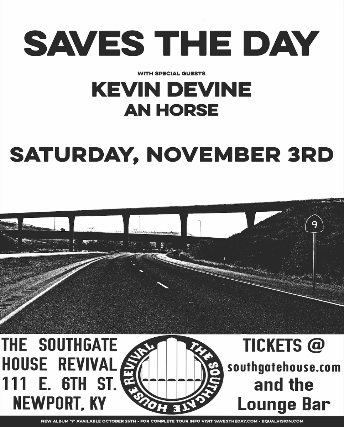
Saves the DayKevin DevineAn Horse
Sat, 3 Nov, 8:00 PM EDT
Doors open
7:00 PM EDT
The Southgate House Revival - Sanctuary
111 E Sixth Street, Newport, KY 41071
TICKET SALES TERMINATED
Tickets are currently unavailable on TicketWeb
Event Information
Age Limit
All Ages
Alternative Rock
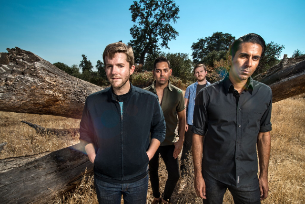
Saves the Day
Saves the Day
Alternative Rock
Saves The Day have been through a lot over the past two decades: Van accidents,
member changes, the emo explosion, and the adventures that carried the act and their
fans from adolescence to adulthood. But they've never had a proper history of the band...
until now. Saves The Day's ninth album 9 tells the story of the band from the perspective
of the band's founder Chris Conley and does it in a way that's as exhaustive as it is
poetic and makes the listener a part of the songwriting process. From a narrative
standpoint, 9 chronicles the epic story of a group of kids from New Jersey who realized
their dream and became international sensations. However, on a more existential level, it
shows how Conley “woke up” and became aware of his own consciousness through his
relationship with music and the unbelievable adventures it inspired since he formed the
act in 1997.
“A lot of the memories that I write about in the lyrics for this album I haven't written
about because they were too painful or complicated. But for some reason when I was
writing, my brain kept coming back to thinking about my entire career from a sense of
reflection for the first time,” Conley says of the process of writing the follow-up to
2013's Saves The Day. 9 opens with the upbeat “Saves The Day,” which serves
simultaneously as a mission statement and love letter to fans before segueing into
“Suzuki,” a song that features the opening line, “On a black and red couch playing a
burgundy Les Paul I played on Can’t Slow Down so many years ago, writing album
number nine right now.” Then again, this meta sentiment isn't so surprising coming from
someone who famously penned lines like, “You want to know who I really am, well so
do I” on the song “See You” from the landmark 2001 album, Stay What You Are.
From there the album takes you back to the earliest days of the band's history of playing
house shows on the crunchy, riff-driven “Side By Side” and drops you into what it's like
to be to on tour with your best friends when all cylinders are firing on the instantly
catchy, psychedelica-tinged “Kerouac & Cassady.” Next we move onto the band's
unplanned rise to stardom and relentless work ethic on the driving and uplifting rocker,
“It's Such A Beautiful World.” “This song is about the Through Being Cool era and
things are starting to heat up,” Conley says of the latter track, which sounds like an
unholy amalgam between Weezer and glam metal. “At this point we are flying to
performances all over the world so in the first stanza I say, 'If we get stuck on a plane,
we’re skydiving to the show.' It's such an incredible life to get to live and we were nuts
for it and enjoying every second of it.”
Unfortunately with every cataclysmic rise to fame comes the ensuing pitfalls of ego and
excess and that's what Conley tackles on “Rosé.” “That song is a bit of a dis track about
certain rock star elements that started to be displayed in the band and I was kind of
surprised that I wrote about it because it isn't something that I've thought about in a
while,” Conley says. The song also sees him approaching the vocals in a way he never
has before that unfolds itself more with each subsequent listen and is as ambitious as it is
artistic. This is followed up with “1997,” which sees Conley once again reflecting on the
band's early days over a distorted bass line and groove that's invitingly relentless and
calls to mind an emo version of Van Halen.
Finally, we arrive at “Rendezvous” and how grateful Conley is of the current lineup of
the band, which includes the virtuosic trio of guitarist Arun Bali, bassist Rodrigo Palma
and drummer Dennis Wilson, who are the band's most consistent lineup to date and take
the musicianship on 9 to stratospheric new heights. “At this point, I've actually dealt
with the conflicts and the challenges in a lifelong career in music and now I have the
guys that I could do this with forever and I'm living the dream again. Life is beautiful, so
I intentionally reference the song 'It's Such A Beautiful World' in the lyrics because that
song is about when things were going crazy for us and we were all so excited,” Conley
says of “Rendezvous” which is layered in distortion-drenched perfection. “We're
through all the reflecting and growing at this point, and we're still out here, and we're
still doing it so the timeline essentially ends with 'Rendezvous' looking into the future.”
However, it wouldn't be a Saves The Day album without a surprise twist--and in this
case it's the album's 21-minute-long climax, “29.” “The final track is seven songs in one
and it's the internal personal timeline of my entire life,” Conley explains. “It starts with
'Heartbeat' because I was hypnotized by that sound as a kid and literally it's my first
experience of waking up to life itself,” Conley explains. The finale goes on to introduce
Conley's love affair with music via “So In Love”; Saves The Day's near fatal van
accident in 2000 on “432”; and a difficult rift with a longtime friend on “Tangerine.”
“One of my main artistic passions is the fascination with how you can compose
extremely long pieces of music but also hold the attention of the listener,” Conley says –
and correspondingly “29” sounds less like prog-rock excess and more like an album
unto itself. Subsequently the movement “Victorian & 21st” recounts Conley's meeting
with a longtime partner; “Angel” is a tribute to his daughter; and the epic experiment
ends with “New Jersey,” which sees him reflecting on his relationship with his parents
and his sometimes difficult but always captivating past one last time, culminating with
the line, “I know it’ll be all right, we are alive in the world.”
Ultimately 9 is sonic evidence not only that there's a reason we are alive in the world,
but it's a miracle that Conley rightfully encourages us to celebrate.
Indie Rock
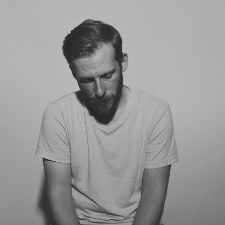
Kevin Devine
Kevin Devine
Indie Rock
The first solo album I heard by Kevin Devine was a demo tape a friend gave me in 1999.
The tape was pared down sound, just a demo recorded in somebody’s basement with a four-track. Hard-strumming acoustic guitar, toe-tapping percussion, a kid singing his heart out. With vocals untouched, and nothing produced, it was music in its simplest form, addictive and compelling.
But there was an additional side to Devine that I discovered when he performed in the indie rock outfit Miracle of 86, who cut their teeth at punk and hardcore shows in the 90s. Devine could easily transform himself from singer/songwriter into a shouting, high-energy, indie rock singer.
After Miracle broke up, Devine continued to pursue a thriving solo career that has earned him an international following, releasing six studio albums to high acclaim—including Brother’s Blood (2010) and Between the Concrete and the Clouds (2011), both charting on Billboard’s Top 200 and the latter peaking at #1 on Amazon.com’s mp3 album chart. In addition, Devine’s released two Billboard-charting records as a member of Bad Books, a collaboration with the indie rock band Manchester Orchestra.
Now with the simultaneous release of Bulldozer and Bubblegum, his seventh and eighth studio albums, the Brooklyn-based singer/songwriter attempts two drastically different sounds on two separate recordings in a dual-album project independently funded through an historically successful Kickstarter campaign.
Bulldozer is laced with folk-rock and pop ballads produced by Rob Schnapf (Elliott Smith, Beck, Guided by Voices).
Bubblegum, produced by Jesse Lacey of Brand New, is a proper rock band record, a more evolved sound from his early days in Miracle of 86; a record with up tempos, feedback, loud fuzz guitars, and catchy hooks that bring to mind the best of the Pixies.
“After Miracle broke up,” said Devine, “I’d write two songs per record that would have been Miracle songs. And when you’re opening for rock bands like I was for so many years, [my band] got really good at pedal-to-the-floor rock…. I had the notion to make two different records, two different ways at the same time.”
In between writing twenty-two new songs and touring with Bad Books in fall 2012, Devine was uneasy about the ethics of using a Kickstarter model to fund an established artist. But he was also disillusioned by his experiences inside the traditional label system. In the late months of 2012, as he continued to write, Devine’s uneasiness with the Kickstarter model began to recede. He proceeded with the belief that he would be doing something different and true, placing his trust in his audience to guide him.
“I’ve made six records. In America they’ve been released on five different labels. It’s a pretty unstable industry… What’s made it a sustainable and a justifiable career for me has been the audience and their close, passionate connection to the music.”
The Kickstarter campaign launched in January 2013, and immediately his audience answered back: within eight hours of the 45-day campaign’s launch, his target financing of 50K to produce, record, and tour both records was met, allowing Bulldozer and Bubblegum to be made and released with complete independence. But it didn’t stop there. Devine’s audience surpassed his expectations, and by the end of the 45-day Kickstarter campaign, he had raised $114,805, more than double his initial target.
“When that audience tells you to keep doing it and here’s the money, it almost renders a very crass thing – the exchange of money over the creative process – into a staggeringly humbling and encouraging experience. When this happened, I felt so motivated I dove into making the records.”
From there Devine set out to make what he had called LP7 (Bulldozer) and LP8 (Bubblegum) on his own terms.
*Bulldozer*
The ten songs that comprise Bulldozer, Devine’s acoustic album, were recorded in L.A. from March to April 2013 and produced by frequent collaborator Rob Schnapf. With Devine on guitar, Schnapf gathered a stellar group of musicians to back him—Russell Pollard and Elijah Thomson (Everest) on drums and bass, respectively; Isobel Campbell (Belle & Sebastian) on backup vocals; and Schnapf himself on guitar, mellotron, and percussion.
The commanding big sound of “Now: Navigate!” with its chiming guitars, tongue-in-cheek wordplay, is a stampede of power pop, as is the quintessential rock/pop sound of “Little Bulldozer.” Songs like “She Can See Me” bring out Devine’s punk rock roots.
“From Here” was written in the days after Hurricane Sandy when Devine put things on hold to volunteer around Staten Island, where he partially grew up, and Brooklyn, where he now lives. Primarily, he came to the aid of two close friends who had lost their homes in the hurricane. Devine aided in food and material drives and played in benefit concerts.
“But it’s one of those things no matter how much you do it never seems enough.”
On “For Eugene,” centered around the death of Eugene Contrubis, one of the many who drowned on Staten Island, Isobel Campbell, known most popularly from Belle & Sebastian, lends her voice to add a moving layer to a song that swells to high emotional peaks.
*Bubblegum*
During the Fall of 2012, as Devine wrote and recorded demos of the twenty-two songs, he divided his catalog into two camps: the acoustic based songs he would record with Schnapf in L.A., and the songs he would record with Jesse Lacey in New York, some of which were written on bass guitar.
Bubblegum, Devine’s “pedal-to-the-floor” rock album, is the product of his special collaboration with Jesse Lacey of Brand New as producer, shaping and writing alongside Mike Fadem on drums and Mike Strandberg on guitar, the two members of his touring group the Goddamn Band. The album was finished in April 2013, recorded at Dreamland Recording Studios in Hurley, NY and at Atomic Heart Studios in New York City.
The twelve songs on Bubblegum create a hard-driving, angular, and mature indie rock sound. Set to the tempo of Pixie-like guitar riffs, as on “Fiscal Cliff,” and Devine’s more socially conscious and politically bombastic lyrics, this is a side of Devine that screams and shouts itself over the feedback. “Nobel Prize” is a head-bouncing intro that captures the record’s relentless energy. “Private First Class,” based on the imprisonment and scandal of Bradley Manning who leaked unclassified documents in Iraq, is a surf/punk- sounding anthem of the highest-measure. But even high-octane rock records need to slow down, and Devine does so on tracks like “I Can’t Believe You” and “Red Bird” without losing consistency or steam.
The record’s most poppy tracks hit back to back with “Bloodhound,” “Bubblegum,” and “Sick of Words,” a catchy song that sounds as if Devine assembled Black Francis, Kim Deal, and Jackson Brown to back him—testament to the Goddamn Band’s musicianship provided by Fadem and Strandberg, with a debt to Lacey who also steps in on bass and percussion, and backup vocals.
*
Things have changed in the fourteen years since I heard that first Kevin Devine demo. Bulldozer and Bubblegum mark a new way to make music. With this simultaneous dual-album release in the fashion of Springsteen, Elvis Costello, Tom Waits, and Bright Eyes, Devine knocks down an old studio model with his audience’s participation. These twenty-two songs in total weave back and forth through our American landscape with bravado, heart, energy, and austerity. The delicacy of Bulldozer delights at every turn, every strum, every word, while Bubblegum turns the volume high, taking you in and out of time, a rock record nonpareil. Listen to them loud.
—Alex Gilvarry, author of From the Memoirs of a Non-Enemy Combatant