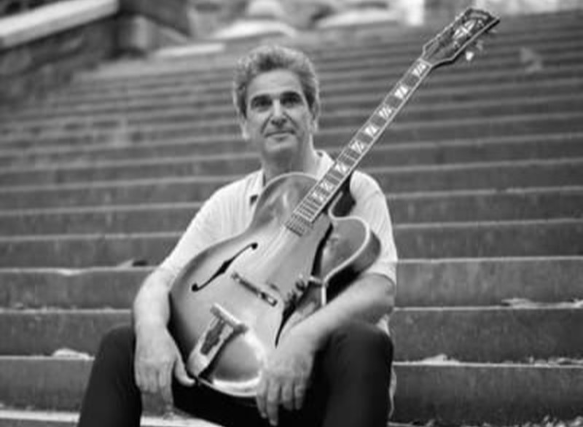
Roni Ben-Hur Trio
Wed, 4 Nov, 9:00 PM - 10:00 PM EST
Doors open
8:30 PM EST
Mezzrow
163 W 10th St, New York, NY 10014
Description
Event Information
Age Limit
All Ages
Refund Policy
All ticket sales are final. We do not offer refunds or exchanges. We do not offer credits for missed shows.
Jazz
Roni Ben-Hur
Roni Ben-Hur
Jazz
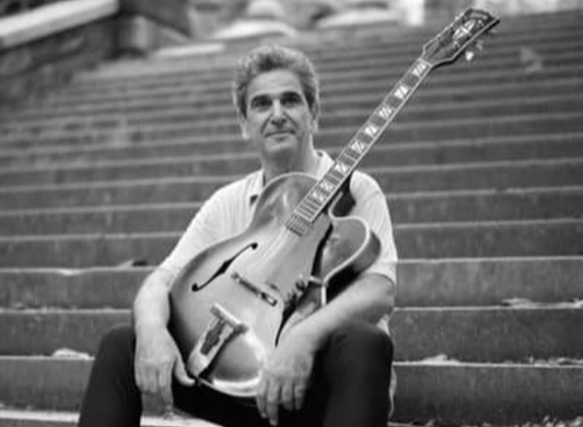
“A limber and inventive guitarist, Ben-Hur keeps the modernist flame alive and pure, with a low flame burning in every note — Gary Giddins, The Village Voice An esteemed, redoubtably swinging guitarist on the New York City jazz scene for the past 35 years, Roni Ben-Hur has been immersed in the music of Charlie Parker, Dizzy Gillespie, Bud Powell and Thelonious Monk since arriving in the Big Apple from Israel in 1985. A protege of bebop piano legend, educator and 1989 NEA Jazz Master Barry Harris, Ben-Hur earned his reputation on the strength of such superb recordings as 1995’s Backyard (with the Barry Harris Trio), 1998’s Sofia’s Butterfly and 2001’s Anna’s Dance (which reunited him with his mentor Harris). A multi-directional player, Ben-Hur has also revealed a strong affinity for Brazilian music on his 2005 album Signature, 2007’s Keepin’ It Open, 2009’s Fortuna and 2011’s Mojave. His 2015 album Alegria De Viver was a collection of intimate duets with legendary Brazilian singer Leny Andrade, once described as “the Sarah Vaughan of bossa nova.” Ben-Hue’s longstanding fascination with Brazilian music now comes to full fruition on his latest recording, 2020’s Samba Do Arraia. Recorded in Sao Paolo, this quartet project, which he co-led with drummer Percio Sepia, features the great Andrade guesting on four tracks. Said the guitarist about his twin passions for bebop and bossa nova: “My affinity for jazz and Brazilian music has to do with my roots being North African. With my family coming from Tunisia, I felt very at home with those rhythms since both the Brazilian and jazz rhythms come from Africa. It all just feels very natural to me.” While Roni continues to embrace the music of Brazil, he also remains steadfastly committed to straight ahead jazz. It’s become one of his enduring signatures over the past four decades. “That swing feeling…you can’t beat that,” he enthusiastically affirmed. “And I was very lucky when I started my career here in New York to be around Barry Harris and all these people around him who just loved that feel. And when you play for that audience, you can sense when the beat is right. You can see that in how they move their head and their body. It’s very authentic, very uplifting, really. You get a shot of energy coming through you when that swing beat comes.” Ben-Hur’s long journey began in a small, provincial desert town in Israel called Dimona, where he was born on July 9, 1962. His family had emigrated to Israel from Tunisia in 1955 during the rebellion against the French colonialists. In 1972, at the age of 10, his surname of Bohobza was legally changed to Ben-Hur. At age 11, he began taking guitar lessons in Dimona and later copied tunes off records by Leonard Cohen, The Beatles, Led Zeppelin and Pink Floyd. He first heard jazz in 11th grade when a friend turned him on to albums by The Crusaders and Chick Corea. “That crossover sound was the start for me,” he said. By age 17, Roni began taking lessons with jazz guitarist Carl Abramovich, generally regarded as the best player in Israel in 1979. “He introduced me to Wes Montgomery, Jim Hall and Joe Pass, and he helped me get started in learning the language of jazz.” Ben-Hur began working in wedding and bar mitzvah bands, which gave him a well-rounded musical background. “We had to play Moroccan music, Yeminite music, Georgian music, Polish music…whatever the ethnicity of the families in that event, we played it.” Between gigging and working as a waiter in Jaffa, Roni had saved up enough money for a flight to New York. He arrived in the Big Apple in 1985 at the age of 22 and soon began hanging out four nights a week at Barry Harris’ Jazz Cultural Theatre in the Chelsea section of Manhattan, where his jazz education deepened. “Barry has an incredible amount knowledge and he is very articulate in conveying that information. Even when he talks about very complex concepts and things that will take you years to digest, it makes sense right away.” After the Jazz Cultural Theatre closed in 1987, Ben-Hur became part of an inner circle of musicians who continued taking classes with Harris’ at his Weehawken home. He played his first gig with Harris in 1991 and in 2002 recorded Live in New York with his bebop mentor. During this time, Roni also worked with such straight ahead elders as saxophonists Cecil Payne and Charles Davis, bassist Walter Booker and drummer Leroy Williams. “My transition of coming to New York and learning jazz and being associated with all these people who are connected to the source of this music required me to adapt and learn a new musical language,” he said. “But there always was a strain of who I am and where I came from in my music. And now I'm more open to ways that I can combine these elements, where I can insert my own roots into the language of jazz and not feel that I'm speaking two languages at the same time.” A dedicated educator, Ben-Hur is also founding director of the jazz program at the Lucy Moses School at the Kaufman Center in Manhattan, which he established in 1994. Through his ambitious outreach programs — his RBH jazz camps, which take place in Vermont during the summer and in the South of France in the spring and fall, and his popular online workshops and masterclasses (https://www.mymusicmasterclass.com/artist/artists/roni-ben-hur) — Roni has continued to pass on the invaluable lessons learned from his mentor Barry Harris to a new generation of aspiring jazz musicians.