TICKET SALES TERMINATED
Tickets are currently unavailable on TicketWeb
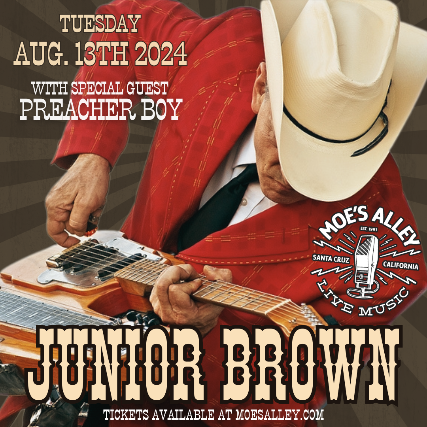
Moe's Alley Presents: Junior Brown w/ Preacher Boy
Tue, 13 Aug, 8:00 PM PDT
Doors open
7:00 PM PDT
Moe's Alley
1535 Commercial Way, Santa Cruz, CA 95065
TICKET SALES TERMINATED
Tickets are currently unavailable on TicketWeb
Description
Moe's Alley presents country and rockabilly guitar legend Junior Brown with special guest Preacher Boy!
Tuesday, August 13th
Doors: 7pm / Show: 8pm
$40 in advance / $45 day of the show
21+
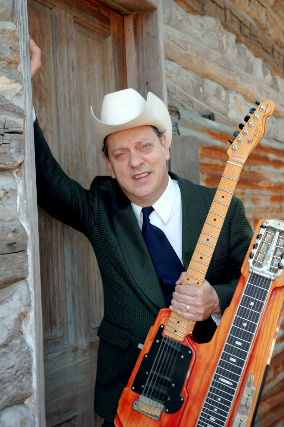
JUNIOR BROWN
With his unique voice, more unique song writing, and even more unique double necked “Guit-Steel” guitar, there has absolutely never been ANYONE like Junior Brown. He’s an American Original. Born in 1952 in Cottonwood, Arizona, Junior Brown showed an affinity for music at an early age when the family moved to a rural area of Indiana near Kirksville. In the following years, Junior began to experience Country music and remembers it as “growing up out of the ground like the crops – it was everywhere; coming out of cars, houses, gas stations and stores like the soundtrack of a story, but Country music programs on TV hadn’t really come along much yet; not until the late fifties.” Discovering a guitar in his grandparent’s attic, he spent the next several years woodshedding with records and the radio. Junior was also able to tap into music he couldn’t hear at home which older, college aged kids were listening to. This was possible due to his father’s employment at small campuses throughout the next decade as the family moved twice again. As a young boy he was able to experience the thrill of performing before live audiences, at parties, school functions even singing and playing guitar for five thousand Boy Scouts at an Andrews Air Force Base jamboree; then while still a teenager, getting the chance to sit in with Rock and Roll pioneer, Bo Diddley. Armed with this broad spectrum of influences, he began to develop a storehouse of musical chops.
PREACHER BOY
Preacher Boy mines the dark edges of Contemporary Blues and Americana with his signature raspy voice, virtuoso National slide guitar playing, and darkly poetic lyrics.
From his genre-bending debut on Blind Pig Records to his latest album on Coast Road Records—his 13th overall—this relentlessly pioneering artist continues to both honor and extend the country blues traditions that inspire him, while infusing his sound with influences ranging from punk rock to political folk. Preacher Boy helped create, define, and advance “alternative blues” as a genre that also spawned artists ranging from Chris Whitley and Alvin Youngblood Hart to the Jon Spencer Blues Explosion and G. Love. Faster and Louder has called him “the godfather of alt. blues.”
Of hIs boot-pounding live performances, Santa Cruz’s Good Times had this to say: “As he beats his long leather boot, four to the floor, his National steel guitar slides and spits a devious storm of gothic Americana and gritty country blues.” Melody Maker described his sound as: “Country blues that marry Nick Cave, Robert Johnson, Woody Guthrie and Tom Waits,” and legendary music publication MOJO declared that, “Preacher Boy is a songwriter of startling originality.”
Event Information
Age Limit
21+
Rockabilly
Junior Brown
Junior Brown
Rockabilly
With his unique voice, more unique song writing, and even more unique double necked “Guit-Steel” guitar, there has absolutely never been ANYONE like Junior Brown. He’s an American Original. Born in 1952 in Cottonwood, Arizona, Junior Brown showed an affinity for music at an early age when the family moved to a rural area of Indiana near Kirksville. In the following years, Junior began to experience Country music and remembers it as “growing up out of the ground like the crops – it was everywhere; coming out of cars, houses, gas stations and stores like the soundtrack of a story, but Country music programs on TV hadn’t really come along much yet; not until the late fifties.” Discovering a guitar in his grandparent’s attic, he spent the next several years woodshedding with records and the radio. Junior was also able to tap into music he couldn’t hear at home which older, college aged kids were listening to. This was possible due to his father’s employment at small campuses throughout the next decade as the family moved twice again. As a young boy he was able to experience the thrill of performing before live audiences, at parties, school functions even singing and playing guitar for five thousand Boy Scouts at an Andrews Air Force Base jamboree; then while still a teenager, getting the chance to sit in with Rock and Roll pioneer, Bo Diddley. Armed with this broad spectrum of influences, he began to develop a storehouse of musical chops.
Early on, Junior realized he had to keep his interest in Country music a secret; “it was like a secret friend I carried around, being careful not to tell anyone (especially girls) about my love for it because I thought they would laugh at me.” It wasn’t until the late 1960’s that Junior Brown would proudly explore the passion for the music he had loved since his early childhood in Indiana. With many prominent figures as his inspiration (Country legends, some who he would work with years later), he spent his nights in small clubs across the southwest. “I played more nights in honkytonks during the Seventies and Eighties than most musicians will see in a lifetime… I did so many years of that, night after night, four sets a night, fifteen minute breaks; I mean after that, you’ve gotta get good or you gotta get out. The early 1970’s California Country dance club scene was particularly competitive, but I learned professionalism and stage demeanor which has served me well to this day.” More recently however, Junior has shown himself to be equally adept at a wide variety of American music styles beyond Country. These include Rock and Roll, Blues, Hawaiian, Bluegrass and Western Swing.
There is a dependable consistency in Junior’s writing style (he writes nearly all his material) yet he’s always full of pleasant surprises. Though Junior always knew he could sing and play what he wanted, he had yet to explore his potential as a songwriter. “I realized no one was going to walk into a club and discover me…so I started hanging out with some songwriters who I’d played some jobs with, and they showed me how to support myself by writing and publishing.” With his writing coming together by the mid-Eighties, Brown upgraded his gear in a way that no artist had ever done. Struggling through each show, going back and forth plugging and unplugging guitar to steel guitar while singing, he had a dream one night about the two instruments mysteriously melding into one. The result was Brown’s unique invention, the “Guit-Steel”, a double necked instrument combining standard guitar with steel guitar. Built by Michael Stevens of Stevens Electric Instruments, the Guit-Steel allows Junior to switch instruments quickly in mid song while singing. According to Brown, his guitar and steel guitar playing became more his own around this time, with less imitation of others and more his own original ideas and licks. This maturation coincided with the development of a completely “Junior Brown” style of songwriting which employs subtle dry wit to some songs – others can be more overtly humorous, or just plain dead serious; like his playing, there is a wide range of styles that when combined can only spell Junior Brown.
In the early nineties Brown and his band (including wife Tanya Rae) relocated to Texas to the active Austin music scene and landed a weekly gig at the Continental club. Having worked as a sideman for many of the Austin-based acts over the years, Junior was already well familiar with the town. His unique and entertaining combination of singing, songwriting, instrumental and production skills led to a seven record deal with Curb Records that began with “Twelve Shades of Brown” in 1993. He later released two albums on the TelArc label. There were several Grammy nods, a CMA (Country Music Association) award for “My Wife Thinks You’re Dead”, movie and repeated TV appearances like Letterman, Conan, Saturday Night Live, Austin City Limits, SpongeBob, X Files, Dukes of Hazzard, Me Myself and Irene, Tresspass, Still Breathing, Blue Collar Comedy Tour 1 and 2, and more recently, Better Call Saul. And there were the Ad Campaigns; The Gap, Lee Jeans and Lipton Tea. As Junior became more well known, he began to collaborate on projects with some of his heroes. These include a duet with Ralph Stanley for which Junior received a Bluegrass Music Association Award (IBMA), a duet and video with Hank Thompson, as well as duets with video and record collaborations with the Beach Boys, George Jones, Leon McAuliffe, Ray Price, Leona Williams, Lynn Morris, Lloyd Green and Doc Watson. He even played guitar for Bob Wills’ Texas Playboys in a radio commercial.
Junior is currently finishing up recording on his latest album, “Deep In The Heart Of Me”. Release date is slated for Spring 2017. Junior’s performance on the promotional song, “Better Call Saul” was recorded and released both as a video on AMC as well as a flexible 33 1/3rd vinyl record included in the show’s box set from Season One. Junior, Tanya Rae and the band continue to tear up the highways and no doubt will be appearing in concert near you one of these days. Seeing Junior live is a definite must, so GUIT WITH IT ’cause he’s AN AMERICAN ORIGINAL!

Dirty Blues
Preacher Boy
Preacher Boy
Dirty Blues
Preacher Boy mines the dark edges of Contemporary Blues and Americana with his signature raspy voice, virtuoso National slide guitar playing, and darkly poetic lyrics.
From his genre-bending debut on Blind Pig Records to his latest album on Coast Road Records—his 13th overall—this relentlessly pioneering artist continues to both honor and extend the country blues traditions that inspire him, while infusing his sound with influences ranging from punk rock to political folk. Preacher Boy helped create, define, and advance “alternative blues” as a genre that also spawned artists ranging from Chris Whitley and Alvin Youngblood Hart to the Jon Spencer Blues Explosion and G. Love. Faster and Louder has called him “the godfather of alt. blues.”
Of hIs boot-pounding live performances, Santa Cruz’s Good Times had this to say: “As he beats his long leather boot, four to the floor, his National steel guitar slides and spits a devious storm of gothic Americana and gritty country blues.” Melody Maker described his sound as: “Country blues that marry Nick Cave, Robert Johnson, Woody Guthrie and Tom Waits,” and legendary music publication MOJO declared that, “Preacher Boy is a songwriter of startling originality.”
~
Preacher Boy is a pioneering Contemporary Blues and Americana artist who arrived on the scene with a career-making performance at The San Francisco Blues Festival in 1995—the San Francisco Examiner wrote that, "Those who arrived late may have missed what could well have been the top act on the entire bill next to John Lee Hooker himself.”
More than two decades later, Preacher Boy continues to deliver his raw, powerful brand of the blues. Of his most recent full-length release, The Rumble Strip (Coast Road Records), Rev. Keith A. Gordon wrote that, "Simply put, Preacher Boy’s performances on The Rumble Strip leave nothing but scorched earth in their wake."
On January 27, 2020, Preacher Boy released See No Evil, a 5-song EP of "hard-edged election-year Americana." This was followed on July 4, 2021, by Six for Three, described as "Possibly the rawest and most immediate album of Preacher Boy's long career."
Preacher Boy’s recording career began with his genre-defying debut on Blind Pig Records. Rolling Stone was an early convert: "Preacher Boy is somewhat like Keb’ Mo’ in his jazzing up of Delta blues styles, but with a more contemporary sound akin to Kelly Joe Phelps or Chris Whitley. The best cuts highlight his wonderful work on National Steel."
In the wake of the album’s release, Preacher Boy hit the road, sharing stages with everyone from Chris Isaak, Cracker, Cake, and Counting Crows, to Jimmy Vaughan, Los Lobos, J.J. Cale, and John Lee Hooker. He then delivered his Blind Pig follow up, described by Blues Access as: "Howlin' Wolf meets Tom Waits by way of Cab Calloway.” The San Francisco Guardian called Preacher Boy the “Charlie Musselwhite for the Lollapalooza Generation.”—a quote that would become a running joke between Preacher Boy and Charlie when they later toured together!
Preacher Boy’s next releases were written, recorded, and released from Europe, where’s he’d relocated and begun touring. His music was described by Melody Maker as: “Country blues that marry Nick Cave, Robert Johnson, Woody Guthrie and Tom Waits.” And legendary music publication MOJO declared that, "Preacher Boy is a songwriter of startling originality."
Preacher Boy next settled in Brooklyn, on the heels of co-writing and recording with Eagle-Eye Cherry and Rick Rubin at New York’s fabled Magic Shop. Preacher Boy earned a Gold Record for his work on Cherry’s Living in the Present Future album, and went on to record his own next album in the city, Demanding to be Next, of which Sing Out said: “Accompanied solely by his keening, propulsive National and Martin guitar playing, Preacher Boy compulsively unwinds a series of often startling, narcotic tales, that prove image-rich and packed with an aura of sweeping drama.”
After a break to focus on writing poetry (courtesy of a grant to live and write in Jack Kerouac’s old house!), Preacher Boy returned to music with a vengeance, as detailed by That Devil Music: "Preacher Boy came roaring back strong with three new albums filled with inspired original songs and choice classic blues covers. Although his country-blues influences are evident in these grooves, Preacher Boy’s sound is entirely of his own making, and he’s been busy making vibrant and electrifying music that stands outside of the mainstream of the insular and tradition-bound world of the blues."
Today, Preacher Boy is riding high on the strength of his recent releases, and his boot-pounding live performances make clear that this relentlessly pioneering artist continues to deliver some of the most compelling modern roots and blues music available anywhere. After a recent performance, Santa Cruz’s Good Times had this to say: "As he beats his long leather boot, four to the floor, his National steel guitar slides and spits a devious storm of gothic Americana and gritty country blues."