TICKET SALES TERMINATED
Tickets are currently unavailable on TicketWeb

Another Planet presents
Lido Pimienta
Fri, 18 Sep, 8:00 PM PDT
Doors open
7:00 PM PDT
Bimbo's 365 Club
1025 Columbus Avenue, San Francisco, CA 94133
TICKET SALES TERMINATED
Tickets are currently unavailable on TicketWeb
Description
21+ ONLY. Please note - there is a delivery delay set for 2 weeks prior to show.
Event Information
Age Limit
21+
Dance/Electronic
Lido Pimienta
Lido Pimienta
Dance/Electronic
As much as an iconoclast, Lido Pimienta is a healer. The trailblazing GRAMMY-nominated multidisciplinary artist —with a practice spanning music, performance, and visual art— has been expanding sonically since 2010. She broke through on 2017’s La Papessa, an experiment in alternative electronica that beat out the likes of Leonard Cohen and Feist for the coveted Polaris Prize. Firmly recognized as the cream of the indie crop, the Barranquilla-born artist now based out of Toronto made her name with a sound rooted in ancestral reconnection by way of the Afro-Indigenous rhythms of her native Colombia, and a DIY punk mentality forged with the tools of electropop.
With 2020’s Miss Colombia, she sharpened cumbia, electropop, dembow, and chamber music into a cohesive and profound reflection on identity, beauty, and the realities of life as a Caribbean woman with Wayuu roots. After her Miss Colombia tour was postponed, Pimienta dug deep into classical music. The result was Gregorian-chant inspired La Belleza, a decolonization of the European classical space born of her ballet composition Lux Aeterna, a historic collaboration with choreographer Andrea Miller that made Pimienta the first woman of color to compose for the New York City Ballet.
But what lies on the other side of the aesthete exploring beauty? Enter Caribenya, her new album coming out July 17. Initially conceived as a B-Side to La Belleza, the record took on a life of its own, a full collection steeped in everything Pimienta has always been about: resistance, connection, and a desire to push sonic boundaries.
"La Belleza shows this highbrow discipline served in a vaso de barro; it doesn't have to make you feel unwelcome to it, but then Caribenya is an offering where you can throw down and shake ass without forgetting where you come from,” she says of the new album.
You can’t forget your past, otherwise you're going to be lost moving forward.”
The album syncretizes all of Pimienta’s influences at a peak moment in her artistry. It’s creative ties to the lush classical symphonies of La Belleza and Miss Colombia’s sonic blueprint of electro-cumbia rebajada are married on Caribenya with ambient melodies, pop sensibility, and dembow riddims grounded in a personal politics. Created with a slew of collaborators including Mexican cumbia collective Turbo Sonidero and Arrabalero of Grupo Jejeje, the songs refuse to be displaced, be it emotionally (floaty ambient-oriented “Libélula”, where she sings about healing a broken heart in nature and continuing to grow) or geographically (soaring experimental dembow closer “No Me Quiero Ir”, where she refuses to leave her love or her land).
The cumbia that rattles through Caribenya takes up major space on lead single “Tóxica”, a diatribe against bad friendship set to a fiery cumbia. The classic Afro-Indigenous revolt rhythm, one Pimienta is a modern master of, is sharpened by her soaring vocals, ethereal harp plucking, a warm viola, a sonidero’s command to dance, and electronic melodies that blow up the song to bursting, rage transmuting into forgiveness. “It became a cumbia because cumbia —and dancing— is about liberation,” she muses on how the track was created. “Me being Colombian and thinking about how cumbia began here, but the biggest manifestations of it recognized worldwide are in Argentina and Mexico, so those are our sister nations in that regard, and there’s something very beautiful about that.”
Elsewhere on the record she explores insecurities: “Talento”, a flowing ambient tropicalia track, is a double-entendre of the word for “talent” and the Caribbean slang for being slow where she takes apart her own self-doubt and tries to reconcile internal flaws. On “Marea” she tackles the Venusian themes as they relate to survival: desire, love, and money through the lens of a young woman who has to hustle and sell herself to provide for her family. The song nods to several types of cultural colonialism, from the gentrification of island lands by rich outsiders to Madonna’s “La Isla Bonita”, one of the first instances of an Anglo artist tapping into so-called Latin imagery. In this song, and throughout her oeuvre, Pimienta continues to embody a champion for those who don’t have the voice to decry their situation.
“I feel like once people are with the work, they'd be like ‘of course this happens’: it happens in New York to older Black Americans, it happens in the Caribbean, where beaches in Jamaica are not open for Jamaicans but for hotels and white tourists,” she says of the philosophy behind a lot of Caribenya’s most potent tracks. “There’s a kinship with Caribbean peoples and South Americans because we have this understanding of colonization. It's important to me to highlight this, because when I think about the Caribbean, I think about Blackness and Indigeneity. I'm not thinking about my great-great-great-grandfather the Spaniard —I'm thinking about the descendants of slaves and genocided people that survived.”
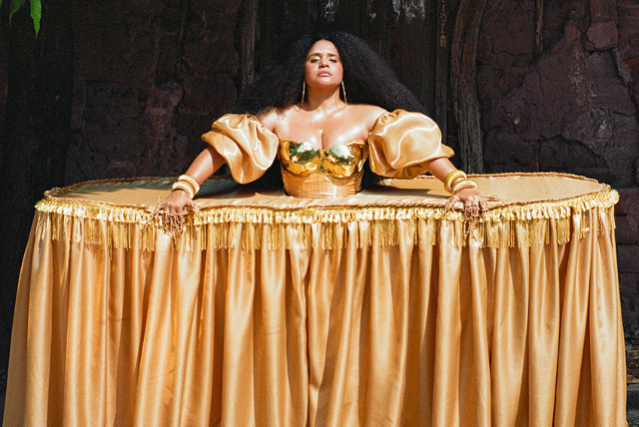
Pimienta’s always been an aesthete. Turning looks and holding a mirror to society’s vanities has come naturally to her since Miss Colombia, where she explored Steve Harvey’s infamous 2015 Miss Universe flub and the racism against him from Colombians, thinking of her own standing as a Black Colombian woman. Where La Belleza saw her embody Venezuelan Saint José Gregorio Hernández’s iconic suit, Caribenya sees her become the divine feminine. Black curls cascading down her back, she dons a gold gown with a wide center, a table where a mother feeds her community and invites them to sit for a feast.
As far as a name, the new album’s title is a playful portmanteau of the word “Caribe” and “Enya”, a nod to the mysterious Irish singer Pimienta is a fan of. That esoteric character has loomed over Pimienta, who listens to her music to concentrate while writing. Often compared to Björk and Natalia Lafourcade in part due to her scope, generation, and the ambition of her work, Pimienta prefers to align herself with the legendarily reclusive ambient diva.
“I really admire the way that [Enya] stays out of everyone's business and that she's not associated with evil in any way, shape, or form; she's just a nice Irish Catholic lady, living in her castle with her cats and her dogs and her piano playing her music, and I think that that is such an aspirational person,” she says “I don't want my daughter to get married or have kids. I want her to fulfill herself and her life. So when I think about Enya…she's that bitch, you know? When she comes out, she's like, oh, I'm gonna make the soundtrack for this multi-billion dollar movie franchise, and I didn't even leave my house to do it. There's something so cunty about that.”
Caribenya synthesizes the lessons of La Belleza’s decolonization of traditional European music into a polished work that still bleeds with humanity. As firmly rooted in the Latin American and Caribbean anti-colonial concerns Pimienta has explored throughout her career, it is an album that relies on the joyous resistance of the dancefloor, the moments of escape we indulge in clubs and beaches and our bedrooms as the world burns. Don’t call it escapism (or worse, theory) — this is one of alternative music’s great experimentalists letting loose while never losing sight of the greater issues.
“Someone told me that making a classical album was gonna be impossible for me and I did it, an “impossible-only-Europeans-could-ever-do-this album”; Caribenya is the counterpart where I got to be less cerebral and have more fun,” she says of the new album. “With my friends, I'm more collaborative, because I usually work alone; it has a sense of joy and collaboration that is very Caribbean. It’s like ‘come over and hang. You don’t need to set up an appointment, you can just knock on the door.’”
Latin Electronica
Chancha Via Circuito
Chancha Via Circuito
Latin Electronica