
Live Nation Presents
HELADO NEGRO & REYNA TROPICAL AS "HELADO TROPICAL"
Sun, 8 Nov, 8:00 PM MST
Doors open
7:00 PM MST
Crescent Ballroom
308 North 2nd Ave, Phoenix, AZ 85003
Description
Live Nation Presents
HELADO NEGRO & REYNA TROPICAL AS "HELADO TROPICAL"
Sunday November 8th 2026
Doors at 7:00 / Show at 8:00
21+
General Admission Ticket: $31 - 35 + fees
Bleachers Ticket: $41 - 45 + fees
Event Information
Age Limit
21+

Latin
Helado Negro
Helado Negro
Latin
Born in South Florida in 1980 to Ecuadorian immigrant parents, the world-building multi-instrumentalist Roberto Carlos Lange stitches together memories, impressions, and atmospheres to make detailed dreamscapes as Helado Negro. He produces, engineers, and mixes his own songs, literally creating and populating his own sonic world. Lange has a degree in Computer Art and Animation from Savannah College of Art and Design and works extensively with video, sculpture, sound, and performance. He brings that toolbox to whatever he makes, and there’s a seeming effortlessness to the complexity. His songs are awash with vibrant melodies, sharp lyrical vignettes, and subtle, even whispered hooks. Since his 2009 debut, Awe Owe, across multiple projects and collaborations, through his breakthrough records, 2016’s Private Energy and 2019’s This Is How You Smile, and to 2021’s Far In, Lange’s work continues to move past easy genre assignments. Showcasing that interest in open-ended multidisciplinarity, in 2022, he and his wife, the artist Kristi Sword, created the multidisciplinary exhibition, Kite Symphony, with Ballroom Marfa—it was a collection of impressionistic installations, drawings and sound pieces that encourages listeners to “open their ears to the sky, the sound of cacti, and the feeling of the wind on their skin.” Lange’s ninth studio record, Phasor, picks up on that interest in the natural world but in the form of pop music. Deep, atmospheric, and meticulously executed, it’s Lange’s tightest collection to date. Lange has been awarded a United States Artist fellowship and a Foundation for Contemporary Arts grant. He lives in Asheville, NC.
Alternative
Reyna Tropical
Reyna Tropical
Alternative
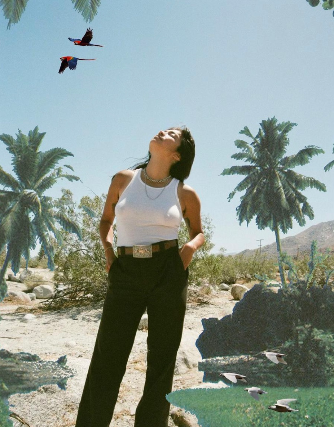
Formed in 2016, Reyna Tropical began as an organic, unhurried exchange between Fabi Reyna and Nectali “Sumohair” Diaz who met during a workshop series for emerging musicians. “Our first EP was so spur of the moment,” Reyna recalled. “What we needed was to document, to just do something for our hearts. Not for money, not for our livelihood. Just for us.” The band formed when Reyna had been immersed in full-time work founding and building She Shreds, the world’s first magazine dedicated to women and nonbinary guitarists, and was itching for a creative release and return to her musical roots. By January 2018, the band’s self-titled EP, Reyna Tropical, dropped and the foundations of the band’s spellbinding and distinctive sound were documented and formed. Best known for their rhythmic, hip-swaying tropical feel, the first Reyna Tropical tracks featured Ableton-made beats produced by Diaz—featuring Afro Indigenous drum patterns and environmental samples—expertly mixed with dreamy guitar riffs and soft vocals by Reyna.
After the EP’s release, and the debut single, "Niña," was featured on NPR Alt.Latino’s “Songs We Love” series, newfound fans and opportunities alike flocked. By year’s end the band was regularly selling out shows, joined as support on Bomba Estéreo’s US tour, and began booking gigs for major festivals and shows including SXSW, Cumbiatón, and Colombia’s Baile Sagrado. The band released another celebrated EP, Sol y Lluvia, in 2019, created and recorded during creatively enriching extended stay in Colombia.
“Things kept coming—studio tours, gigs, and different opportunities,” Reyna said while reflecting on the changes the band went through during the transition. “We were like, ‘Whoa, this is so weird! It’s working,’ but we didn’t even know what it was working for.” In 2020, after eight non-stop years building a business without time off, Reyna withdrew to nature for a community retreat. It was during this moment of stillness that the purpose of her life’s work, beyond running She Shreds Magazine, crystallized. For the next two years, Diaz and Reyna immersed themselves in a tropical journey guided by the music—from Cartagena, Colombia to Fajardo, Puerto Rico and Cuaji (la costa chica de Guerrero)—along the way, invited into a harmonious relationship with local land, culture, and music wisdom stewards. Malegría is the culmination of self exploration fortified through an attunement to land—alongside Diaz and through his passing. From the interludes to the found sounds, Malegría offers a home to diasporic beings de aquí y de allá, diasporic beings who are in the process of searching for and returning to ancestral roots.
On “Cartagena,” the bright, multi-layered rhythms and vocals sing of feeling caressed and energized by the elements, and, at the core, there is the sense of a mutual exchange of trust and care between her and the land. By contrast, “La Mamá,” which opens in a seemingly-serene rainforest, builds into a drumline-backed battle cry denouncing the commercialization of healing and the spiritual tourists who seek only to extract from the environment—medicinal, or otherwise.
The interludes, which weave between each musical track, unfold a narrative all their own. “Goosebumps” and the subsequent “Singing” each offer peeks into the beautiful, unexpected push-and-pull that can transpire amid symbiotic collaboration. We, as listeners, are invited into the creative exchange between Diaz and Reyna, and the growing sense of power Reyna has found and is now sharing with others through her music. Meanwhile “Mestizaje” and “Queer Love and Afro Mexico” work together to chronicle the unlearning of erasure under a flattened definition of unity and, instead, uplift the importance of naming and celebrating distinct multifaceted identities and histories.
These sounds seamlessly blend into the final track, “Huitzilïn,” a tranquil, grounding ballad in which Reyna announces finally feeling her body, her spirit, her soul, and listening to all that surrounds her. “Huitzilïn,” the Nahuatl word for “hummingbird,” is a symbol of Indigenous strength in Mexico thought to guide those who are struggling to find their way home.
“I’ve always wanted to have a home—a place or a sound or a person to go to—because I think our people, who are severed from our lands and our histories and our stories and our communities, have for generations not really known where to go,” Reyna said. “There are times on stage where I can feel that my movement isn’t my movement. I can feel that I’m being moved by and I’m speaking for other people. I know in my body when my ancestors are there, when a decision is us.”
Whether enjoyed during listening parties or infectious live sets, the music will move listeners and irresistibly command a jump—into action in protection of the land, into the arms of a crush, into your own power and fearlessness, into steady body rolls along to the beat. Malegría offers us all a chance to witness history in the making.